Mental-health stigma and testimonial credibility
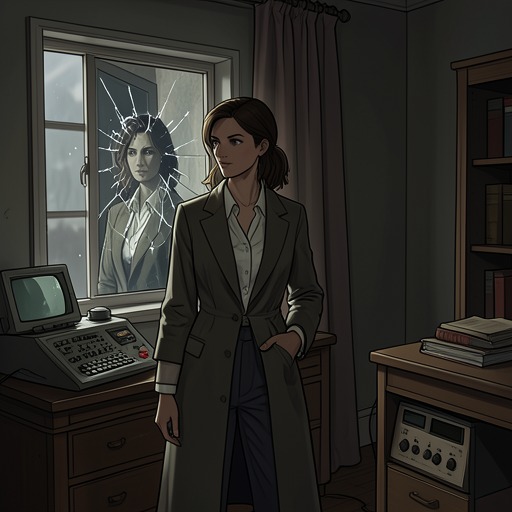
The Woman in Cabin 10Mental-health stigma and testimonial credibility describe the novel’s recurring conflict between what Laura Blacklock reports and the assumptions others attach to her anxiety, medication, and distress. After she describes seeing a woman and later hearing a splash, the absence of corroborating evidence is compounded by a personal disclosure: Ben Howard tells Johann Nilsson that Laura has not been sleeping since a break-in and takes antidepressants. Nilsson’s inquiry turns those circumstances into grounds for questioning her account. The narrative, however, keeps the distinction clear: vulnerability may complicate how Laura is heard, but it does not by itself prove that her perception was false.
The testimony under suspicion
In his conversation with Laura, Nilsson raises her sleeplessness after the break-in and then her use of antidepressants, glancing at the partly used packet beside the bathroom sink. The disclosure stings not only because it is private, but because Ben has supplied it without her permission. Laura concludes that he has given Nilsson personal details that make her appear neurotic and unreliable, while failing to support her report. She is angry with both men, but especially with Ben, whose confidence she had trusted.
Laura does not deny taking medication or drinking while taking it. She objects to the inference that those facts invalidate her testimony. She explains that she has anxiety attacks, not delusions, and argues that even a person experiencing psychosis would not thereby be incapable of seeing an event. Her point is about the difference between a mental-health history and proof about a specific claim: medication is not evidence that a reported sighting did not happen.
Nilsson says that there is no evidence supporting Laura’s account and that what she believes happened resembles her own recent traumatic experience. He recasts her sequence of observations as a mistaken leap: she saw a girl, later heard a splash, and joined the two into a murder allegation. Laura rejects this reasoning, insisting that her poor sleep, drinking, and recent break-in do not explain away what she saw. The dispute therefore concerns more than whether investigators have corroboration. It is also about who gets to define her perception as observation or delusion before the underlying event has been established.
A history that complicates, but does not settle, the claim
The confined, dark space in which Laura later waits makes her attend to her body and to the timing of her medication. She recalls taking a pill from its packet after seeing Nilsson on Monday morning but leaving it on the counter rather than swallowing it. She had wanted to demonstrate to herself that she was not dependent on the tablets; after an argument with Ben and a visit to the spa, she forgot about the dose. By the time she counts backward, she thinks she may have gone forty-eight to sixty hours without medication and becomes frightened by the possibility of withdrawal.
Her recollection gives that fear a longer history. Laura remembers a first panic attack in adolescence, perhaps at thirteen or fourteen, which she kept secret because she thought it marked her as strange. The attacks returned around the time of her A levels, and managing anxiety began to feel like a constant task. University brought a period of improvement. After graduating, she met Ben, began working at Velocity, and had her own home in London; she then describes herself as falling apart, rather than steadily leaving the problem behind.
Laura also remembers an earlier attempt to stop taking medication under her GP’s supervision. Her dose was reduced from forty milligrams to twenty, then ten, then ten every other day before she stopped. Two months later she had lost thirty pounds and was at risk of losing her job because she had stopped going into the office without explaining why. Her GP considered withdrawal a possible explanation and restored her original forty-milligram dose; Laura recalls feeling better within days. This history makes the prospect of missed doses frightening to her, but it does not supply Nilsson with proof that her earlier report was mistaken. The novel presents the history as lived context, not as a substitute verdict on the event.
Public speculation and the manufacture of an unreliable witness
The credibility problem escapes the ship and appears again in a Whodunnit forum thread about Laura’s disappearance. An anonymous poster claims personal knowledge of her family, describes her as unstable because she has taken medication for years, and suggests suicide. Other contributors speculate about whether her former partner, Judah Lewis, might be responsible, based on reports that he was abroad. The discussion converts uncertain information into competing stories about a missing woman, with her treatment history used to make one particularly damaging explanation seem plausible.
Judah answers under his own name. He corrects the anonymous poster on a specific point: Laura takes medication for anxiety, not depression. He rejects the assumption that medication makes her unstable or suicidal, and clarifies that although he was in Russia, the body mentioned in the discussion had not been identified as Laura. The thread’s administrator agrees that the conversation has become unpleasant speculation and closes it. The sequence shows how quickly an unverified account can borrow the language of intimacy and concern to discredit a missing person, while the correction must carefully separate what is known from what is being inferred.
A later family email records how the uncertainty becomes personal. Scotland Yard has asked Judah to identify photographs of clothing received from investigators handling the case; he recognizes Laura’s distinctive vintage boots and other garments. The family is devastated, but the email explicitly says that the body remains in Norway and that they have no further information. Clothing associated with Laura is not the same as a confirmed identification of her body. A subsequent newspaper report states that Laura was found alive and that the earlier communication of the clothing evidence was handled poorly. These reversals expose the consequences of treating suggestive evidence as conclusive: public discussion can harden around a presumed death before the facts warrant it.
Visible illness, disguise, and the limits of appearance
The novel places Laura’s less visible anxiety beside Anne Bullmer’s visibly marked cancer treatment. At the first dinner, Anne wears a scarf over her scalp and a gray wrap; her pallor, absent eyebrows, and prominent cheekbones make her look markedly ill beside the healthy-looking group. She later says she is feeling somewhat better, though tired, and explains that she has finished her latest chemotherapy treatment for the moment and expects radiotherapy after returning. At another dinner, a bruise shows at her collarbone. Anne attributes it to a shower fall and says she bruises easily as a side effect of chemotherapy.
These details make illness visible as a changing physical condition, but they also show how readily appearance can be read as a complete account of a person. Laura initially has to revise her impression when she sees the woman she recognizes as Anne transformed by dark hair and carefully drawn eyebrows. The face that had seemed gaunt and prematurely aged becomes, with the hair and brows, young and healthy-looking. Appearance is not reliable confirmation of identity, just as Laura’s medication is not reliable disproof of her testimony.
That instability is central to the later revelation: the woman presented aboard as Anne is an impersonator, while Anne has been dead since the ship left England. Richard Bullmer had prohibited Cole Lederer from photographing his wife; the restriction had seemed attributable to Anne’s self-consciousness, but it also prevented compromising images from exposing the substitution. The impersonator and Anne share height, weight, and broad cheekbones, while their eyes differ. Hair, eyebrows, clothing, and the scarcity of photographs together shape what observers think they have seen. Here, control of evidence and the performance of a healthy or ill appearance become part of the same problem: visible signs can prompt belief, but can also be arranged to mislead.
Credibility, evidence, and consequence
The novel does not make Laura’s account credible simply because other people mistreat her, nor does it treat distress as proof of unreliability. Instead, it separates several questions that the characters and forum participants repeatedly collapse: what Laura experienced, what can be corroborated, what her medication is prescribed for, and what conclusions may responsibly be drawn from incomplete information. Nilsson’s lack of evidence is real within the confrontation, but his appeal to trauma and medication does not resolve whether the reported event occurred. Judah’s correction likewise does not establish Laura’s whereabouts; it restores the distinction between anxiety treatment and an unsupported claim of suicidality.
The later discovery that the woman posing as Anne was not Anne gives the reader a concrete reason to distrust confident judgments based on an incomplete view. It does not retroactively verify every perception Laura reports, but it demonstrates that concealment and manipulated appearances are active features of the mystery. Meanwhile, the clothing photographs, the unconfirmed body, the forum’s speculation, and Laura’s eventual survival show how a fragment of evidence can acquire an unwarranted story around it. The novel’s critique of mental-health stigma therefore rests on a precise imbalance: Laura is asked to defend her credibility through personal medical disclosures, while those who doubt or speculate about her repeatedly exceed what the available evidence can establish.